Anatomy & Physiology
NAME: _____________________________
Exam 1. February 21, 2002
Use Scantron for Questions 1-30.
1)_____ An IPSP is: A) a hyperpolarization. B) produced by opening sodium channels. C) produced by opening potassium or chloride channels. D) A & B. E) A &C.
2) ______Inhibition of acetylcholinesterase results in: A) less release of acetylcholine. B) more release of acetylcholine. C) elevated levels of acetylcholine in the synapse. D) reduced binding of acetylcholine to its receptor. E) none of the above.
3) ______ The choroid plexus: A) is a network of nerves. B) is part of the reticular activating system. C) produces melatonin. D) produces cerebrospinal fluid. E) none of the above.
4) ______Prozac acts as
an anti-depressant because it: A) depresses serotonin levels in the
brain.
B) increases endorphins in the brain C) selectively inhibits the reuptake
of serotonin. D) increases release of epinephrine. E) none of
the above.
5) ______Damage to Broca's area results in: A) inability to understand spoken language. B) inability to articulate words. C) loss of fine motor control of limbs. D) loss of consciousness. E) the tendency to talk like newsman Tom Brokaw.
6) ______ White matter tracts that allow neurons in opposite hemispheres to communicate with each other are: A) association tracts. B) commissures. C) pyramidal tracts. D) projection tracts
7) ____ The personality changes experienced by Phineus Gage were due to: A) damage to his hippocampus. B) the Enron scandal. C) damage to his corpus callosum. D) damage to his prefrontal cortex. E) damage to his postcentral gyrus.
8) ______ The lobe of the brain that is most involved with vision is the: A) frontal lobe. B) occipital lobe. C) retinal lobe. D) parietal lobe. E) temporal lobe.
9) _______ The midbrain, pons, and medulla oblongata make up the: A) metencephalon. B) peduncles. C) brainstem. D) limbic system. E) diencephalon.
10) _______ The structure that was split in the "split brain patients" was the: A) frontal lobe. B) hypothalamus. C) corpus callosum. D) hippocampus. E) Anderson's Pea Body.
11) ________A fold of the cerebral cortex is officially known as a(n): A) gyrus. B) sulcus. C) fissure. D) corpus. E) folia.
12) ______ The loss of fine motor control after alcohol intake is due to its effect on the: A) cerebellum. B) frontal lobe. C) parietal lobe. D) midbrain. E) wallet.
13) _____The part of the brain which regulates alertness is the: A) hippocampus. B) limbic system. C) reticular activating system. D) epithalamus. E) arbor vitae.
14) ______ The simplest reflex arc is a: A) monosynaptic reflex arc. B) withdrawal reflex. polysynaptic reflex arc.
D) crossed extensor reflex. E) Joan of Arc.15) _______Centers for feeding behavior (thirst/satiety), body temperature regulation, and autonomic control are foun in the: A) thalamus. B) hippocampus. C) limbic system. D) hypothalamus. E) yellow pages.
16) ______ The layer of the meninges that is in directly contact with the brain is the A) dura mater. B) pia mater. C) arachnoid. D) Iraqnerd. E) hey, whatsamater wid you?
17) _______ Dura mater literally means: A) tough mother. B) brain blanket. C) tough sheet. D) hard material. E) durable cover.
18) _______ Since there is a higher incidence of Parkinson's disease in people living in rural areas and farms, one possible cause of the disease is exposure to: A) cows. B) pesticides. C) chewing tobacco. D) sun. E) Garth Brooks songs.
19) _______ Muscarinic and nicotinic are types of: A) adrenergic receptors. B) monoamine receptors. C) acetylcholine receptors. D) glutamate receptors. E) cigarette brands.
20) _____ The area of skin innervated by a single spinal nerve is called a/an: A) dermatome. B) somatosensory cortex. C) plexus. D) dermatoid. E) homunculus.
Matching: Match the neurotransmitter with the appropriate description. 21_____A "feel good" neurotransmitter. A) Enkephalin or Endorphin 22_____ MDMA (Ecstasy) promotes its release B) Acetylcholine 23_____ An "endogenous opiate" C) GABA 24) _____Barbiturates activate its receptors(a mimic) D) serotonin 25_____ Transmitter of neuromuscular junction. E) Glutamate (glutamic acid) 26) _____ Its receptor is usually a chloride channel. Always inhibitory. 27_____ Neuropeptide 28_____ High levels are toxic, as produced in a stroke or Lou Gehrig's disease 30_____ Its receptors are attacked by immune system in myasthenia gravis.
Neurotransmitters are generally stored in _________________________________. Exocytosis is
generally stimulated by the entry of ________________________ into the presynaptic terminal.
Transmitters diffuse across the _____________________ and bind to ___________________ on
the _______________________ membrane. This binding results in the opening of
__________________, and either an _____________________ or an ____________________
is produced. After binding, the neurotransmitter is removed or degraded.
ACh is inactivated by _________________; monoamines first undergo ____________________
and then are degraded by the enzyme ______________________ ______________________.
The two classes of adrenergic receptors are __________________ and ___________________.
Autonomic reflexes are slower than somatic reflexes because of the extra __________________
and the axons of the postganglionic neurons have a small diameter and have no _____________.
Compare and Contrast the Sympathetic Nervous System and the Parasympathetic Nervous System on the bases of the following characteristics: (12 pts)
SNS PSNS
1) Regions of CNS that
are the origins of the
pre-ganglionic neurons.
2) Transmitter released by
pre-ganglionic neuron.
3) Transmitter released by
post-ganglionic neuron.
4) Effect on heart rate
(increase,decrease, or no effect?)
5) Effect on pupil size
(dilate, constrict, or no effect)
6) Effect on blood flow to
intestines? (increase, decrease,
or no effect)
Where would one find the "cauda equina?" Be specific. What is the clinical importance of this structure? (4 pts)
What is one advantage of an electrical synapses? (2 pts)
Acetylcholine, glutamate, GABA and Serotonin can act directly or indirectly Š what does this mean? ( 4pts)
Describe the function or a significant feature of the following regions of the CNS: (2 pts each)
Temporal Lobe
Pre-central gyrus
Post-central gyrus
Ventral horn of spinal cord
Dorsal root of the spinal cord
Cervical enlargement (of spinal cord)
Arbor vitae
Superior colliculus
Hippocampus
Thalamus
Extra credits:
In which lobe or brain region is the gustatory cortex found?
Why does a pallidotomy (cutting or lesioning the globus pallidus) relieve some symptoms of Parkinson's disease?
OK, now you can name 3 living Americans or non-Americans who are affected with Parkinson's disease.
Why is L-Dopa or Sinemet used to treat Parkinson's disease rather than simply giving the patient dopamine? (2 pts)
Deprenyl (Selegiline) is a monoamine oxidase inhibitor (MAO-I) that is used to treat ParkinsonÕs disease and is also used as an antidepressant. Why would a MAO-I be affective as both an antidepressant and as a treatment for Parkinson's disease? (4 pts)
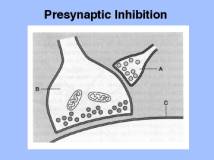
In the diagram below, terminal A forms an inhibitory synapse with terminal B. Explain why the response of C to stimulation by B is less when A is also activated. (4 pts)
![]() |
![]() |
![]()
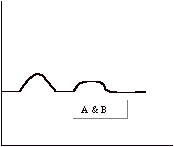
Response of Cell C
A split-brain patient is shown a picture of a woman talking on a telephone. The picture is shown briefly in her left visual field. When asked what she saw, she could only say that she saw a woman. When asked what the woman was doing, the patient was confused and guessed that the woman was skipping rope. However, the patient could write the answer "telephone "using her left hand. Explain the basis of this phenomenon. (5 pts)
While attending the Winter Olympics, Bob "Rosebud" Sledaire mistook the ski-jump for the bunny slope. When he was separated from wreckage that once was his Flexible Flyer Sled, an injury to the left side of his spinal cord was discovered. He lost motor control of his left leg and also touch sensations in his left leg. However, he could feel pain and temperature in his left leg, but not in his right leg. The doctor told him that he had Brown-Sequard syndrome. Explain the anatomical basis of his odd symptoms. (5 pts)
Outline a stretch reflex, e.g., the patellar or "knee-jerk" reflex. (5 pts)